
There’s a version of this post that opens with a tools list. Clay for enrichment, Apollo for sourcing, n8n for automation, Lemlist for sequences. I’ve written that version. I’ve also watched it age badly every six months when something new comes out and the stack reshuffles.
What I’ve noticed- both from building GTM infrastructure at Invigilo and from talking to founders doing the same thing- is that most teams start with tools and work backwards. They see someone on LinkedIn talking about their $300 setup replacing $300k teams, copy it, and then spend the next few months wondering why the outputs don’t match the case study.
I’ve said it before, I’ll say it again: GTM engineering is one piece of this. It’s not the whole thing. I have to resist the urge to experiment with the tools and nail these steps first:
1. customer, customer, customer
- 3 subsets of customers: (user, decision maker, people who’re in the room during decision making)
- priorities of each subset (what makes them good look and who they report to)
- define industry + company stage clearly (Lenny’s Newsletter explains it well)
- map out urgency / trigger events of the problem they’re trying to solve
- check for buying signals (recent tools, hiring, funding, behavior)
- validate scale (can you find 50–100 real matches today?)
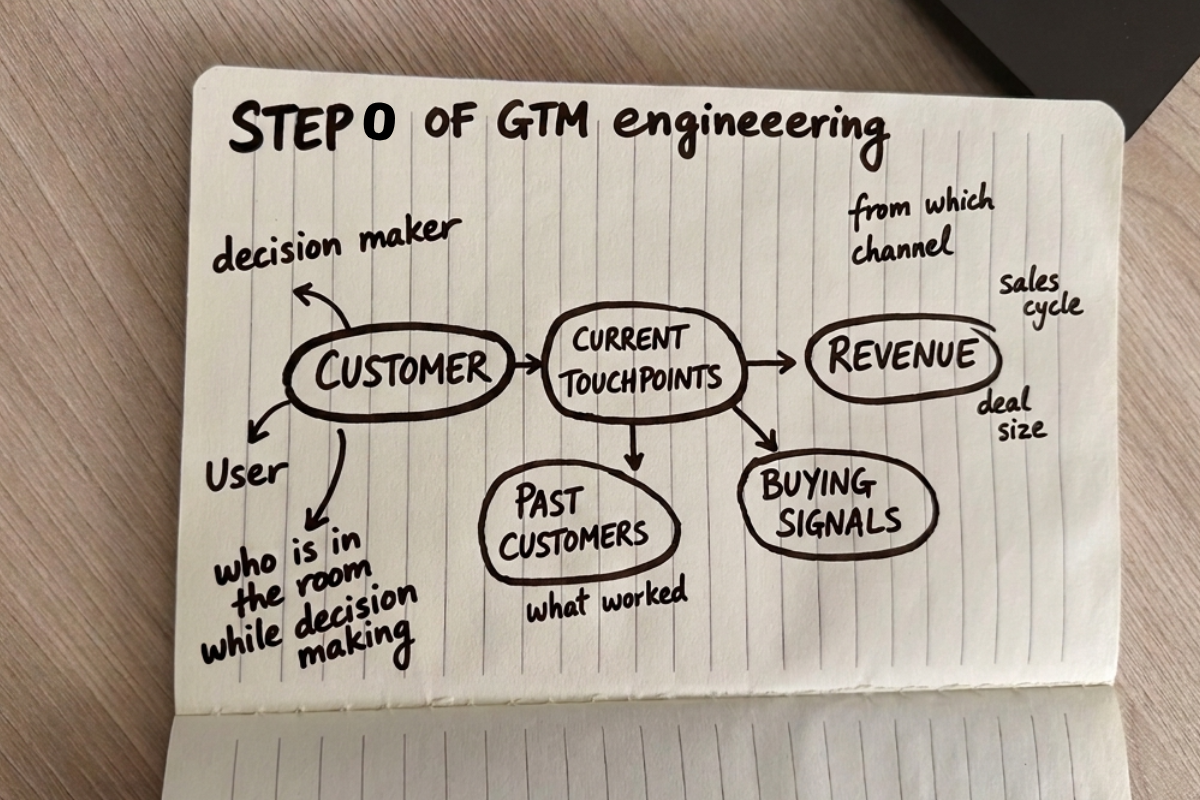
2. Map what revenue actually looks like
What does a closed deal look like? What size, what sales cycle, what does the buyer need to see before they move? This shapes everything downstream- how you prioritise channels, what counts as a qualified lead, what “working” means for your outreach.
3. Define the pipeline stages that reflect your actual process
Where do leads come from, what moves them forward, where do they stall, and what information do you need at each stage to make a good decision. Take a pen and paper and map this out.
4. Mine what already worked
Past customers, closed deals, even deals that got to late stage and fell apart — there’s more signal there than in any tool. What did those people have in common? How did they find you? What made them move fast? This is the most underused input in GTM strategy.
5. Now build the stack
Once you know who you’re going after, what the pipeline looks like, and what signals matter- the tooling decisions get a lot simpler. Sourcing, enrichment, outreach, tracking, handoff. Each one has a clear function, and you can evaluate options against that function rather than what’s shiny at the moment.
The teams I’ve seen get this right aren’t necessarily using the most sophisticated stack. They’re using a stack that fits a strategy they actually understand. To their specific niche use-cases.
Fix the foundations first. The tools follow.